
Hot fans
Choosing a Fan
A beginner should begin with small fans, like our fans sized single layer 24"x41", which will be a good choice. With these smaller fans, you can learn how to move the feather fans when you turn, understand what the fan conceals as you change your position, and develop essential wrist control. Practicing in front of a mirror is highly recommended.
Once you've mastered the fundamentals and developed strength and coordination, you can progress to larger, more complex fans for greater visual impact and advanced techniques:
Larger 2 -Layer Fans (e.g., 30"x54" or 34"x60"): These are the quintessential advanced fan. Featuring two layers of feathers (often different colors), they add incredible depth, texture, and versatility. You can work with just one layer exposed for subtlety, reveal the second layer for a burst of color and volume, or use both together for maximum fullness. Mastering the techniques to smoothly open, close, and manipulate the two layers independently or together adds a whole new dimension to your fan work. They are heavier and require significantly more strength and control than single-layer fans.
3 layers or 4 layers: Some advanced fans feature slightly longer handles. This provides greater leverage for certain types of spins and manipulations but changes the balance point, requiring adaptation in your technique.
Fans with Specific Feather Types: Advanced dancers might explore fans made with specific feather types (like high-quality ostrich drabs or certain pheasant feathers) known for their particular drape, movement, or durability under rigorous use.
Moving to these advanced fans allows for: more expressive and dramatic choreography, complex layering effects, enhanced concealment/reveal techniques, and a truly captivating stage presence. Remember, the increased size, weight, and complexity demand continued diligent practice, often still in front of that mirror, to maintain precision, fluidity, and safety."
Holding the Fan
When you first handle your fans, be sure to spend some time gliding them through the air and feeling the resistance of the feathers against the air. This is something you want to work with, not against. Working with that resistance will give you grace and energy.
While you practice handling the fans, keep in mind the placement of your hands when you find a move or pose you like. The key to fan dance choreography is keeping track of the positions of your hands and arms as well as the positions of your fans.


Cup and Reveal
This is the most basic of cover-and-reveal. As with all the moves to follow, the most important thing is to be sure that you are covering what you intend to cover.


Side Pull
This is simple move that engages your lower body and gives the viewer movement to watch without revealing your torso. Layer the fans one over the other in front of you. Pull out the bottom fan rather than merely raising the top fan; it’s a slinkier move. You can also swirl the fan over your head before you bring it back down to cover the other, then pull out the one on the bottom and swirl it as well.


Clamshell
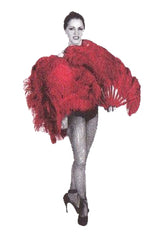
This is a beautiful reveal that you can do multiple times in a number. Simply clasp one fan in the back and one in the front, and turn your hands at the wrist to drop them without moving your arms, then pull them back up and drop them again. Flirt! For a variation, Try dropping them back up and flutter both while you hold the pose.

Clam Face
This is a bit of a comic move. In general I don’t recommend letting the fans get in front of your face, but when you do this the audience loves it. Bring the fans together in front of you, and then raise them to obscure your face. Slowly open them, and then leave one at you hip while you hold the other behind your head and flutter it.


Heartbeat
Bring the fans up, allowing the staves to make a straight line across, as in the photo, then turn your thumbs up, running the tips of the fans together to keep from revealing between them. Hold them in the resulting heart shape, and make them beat by flicking them slightly forward and back several times.


Tail Feathers
Rest your hands against your thighs, as shown. The fans will cover your derriere. Drop you hands, as shown, to reveal. Bring the fans back up, and pull your waist, giving another reveal. Drop them to cover, and then lift them again. Turn around to face the viewer and spread the fans open as in the Rising Sun move.


Reverse Tail Feathers
This is what Tail Feathers like if you hold the fans with the curve of the feathers going over your fingers rather than your thumbs. Look how cute! Curling back or curling forward, holding a showgirl-style feather tail is always a winning pose.


Wings in Profile
Hold your knuckles against your shoulders so that the fans are parallel behind your head, then pivot your body to the side and open the fans out.


Dramatic Cleavage
Hold the fans in front of you, then open them out to the sides. Cross your arms tight against the sides of your rib cage. Bring the fans in close to frame your upper torso and lean forward, showing cleavage. Shimmy the fans slightly with your hands.


Rising Sun
Hold the fans over your head layered over each other .Then bend your wrists so that the backs of your hands move away from the top of your head, so that the fans open up over you, as in the picture. It takes practice to get this to look even, but it is a fabulous reveal!


